Saturday, July 10, 2010

Return from East Africa

Peter Kololi teaching in Singida, TZ Bus accident on the way to Tanga, TZ

EPI team on the east coast of Kenya

Tanzania and Kenya
One week ago I returned from Tanzania and Kenya. This ministry is all about equipping the African pastors so that they can become better teachers. To that end, I always try to have a number of Africans teach with me whenever possible. In Dodoma and Singida, TZ, Wilbert Seme, Peter Kololi, and Peter Minja all taught with me. At our final conference in Kilifi, KE, 4 Africans taught with me: Ernest Mwilitsa (my host); Michael Taari from Nairobi; George Kariuki from Murang'a; and Obed Magoko from Karatina. They did excellent work. A number of people commented to me especially on Michael Taari's applications and examples drawn from real life. That is why I always tell my African friends: "You can teach this material better than I can, because you know the language, you know the culture, and you know the people because you are one of them."
Democratic Republic of Congo (DRC)
Equipping the African church leaders enables the work of EPI to spread to new places indigenously, without my presence. A perfect example of that is what is happening in DRC. Theophile Rugubira of Rwanda and Martin Odi of Uganda led an all-African EPI team to Bukavu in eastern DRC, and just completed EPI's second all-African conference there. Here is part of Martin's report to me on the work in DRC: "The work in DRC is excellent. In my opinion I am praying that the Good Lord will provide more funding to us to teach in Congo than any other place in the great lakes region of Africa, apart from the mentoring classes we want to do in all places. I think the DRC is more hungry and thirsty for these teachings than any place I have ever been in my life! and I mean it. Brother Theo will give a better report than me. But it is awesome! Wow, the army chaplains where drinking everything we said, and have invited us to talk to them in all places. There is a wide open door of ministry in this area than any other."
The value of translating EPI's written materials
An important part of the equipping process is providing the African pastors with excellent biblical materials, and then translating them into their own languages. Thus, while I am home I spend most of my time researching and writing. The value of this was brought home to me in an email I recently received from a Kenyan pastor, Samuel Mwangi. He said this: "I have gone through the EPI website and read some of the materials you have posted in it. I am greatly impressed by the level of research potrayed by those Pastoral Training Materials. They are simple to understand and relevant to our context. The depth and the organisation of the materials is commendable. It is easy to read and its stimulating. Any serious minister will find the truths you have written relevant. You have done an in-depth look at the themes you selected. It is a carefully structured research work. Your work covers a wide range of spiritual issues touching the pastoral ministry. Your resources are the kind of materials I have been longing to come across for my spiritual growth and also for those the Lord has entrusted to my care. It will help us equip a generation of church leaders."
Fun on the road
African travel often presents some challenges. This time, on the lengthy bus ride from Singida to Tanga, TZ, there was a large, disabled lorry parked on the road. As our bus approached it, another vehicle was coming in the other direction. Consequenly, the bus driver slammed on the brakes and jerked the wheel to the left (vehicles drive on the left-hand side of the road in TZ) to avoid smashing into the back of the lorry. The result was that the bus went off the road and into the ditch. The bus ended up at an angle, but fortunately did not fall on it's side. Thanks be to God that no one appears to have been hurt (with the possible exception of one woman who had leg problems, but I don't know if that preceded the accident or not). The accident happened at night. We were still about 30 miles from Tanga. Everyone had to find alternate modes of transportation. Passing motorists picked up some people. I was able to call my friend Joram Ibrahim who, fortunately, owns a car and was able to come and pick me up. I often think that it is the prayers of you, my friends and supporters, that make a difference in situations like this. Thank you.

Report "from the field" (Tanzania)

George Kariuki receiving gift from Arusha, TZ TOT participants Tanga, TZ TOT participants
Dar es Salaam conference in outdoor church


The following report was sent while I was in Tanzania about 3 weeks ago:

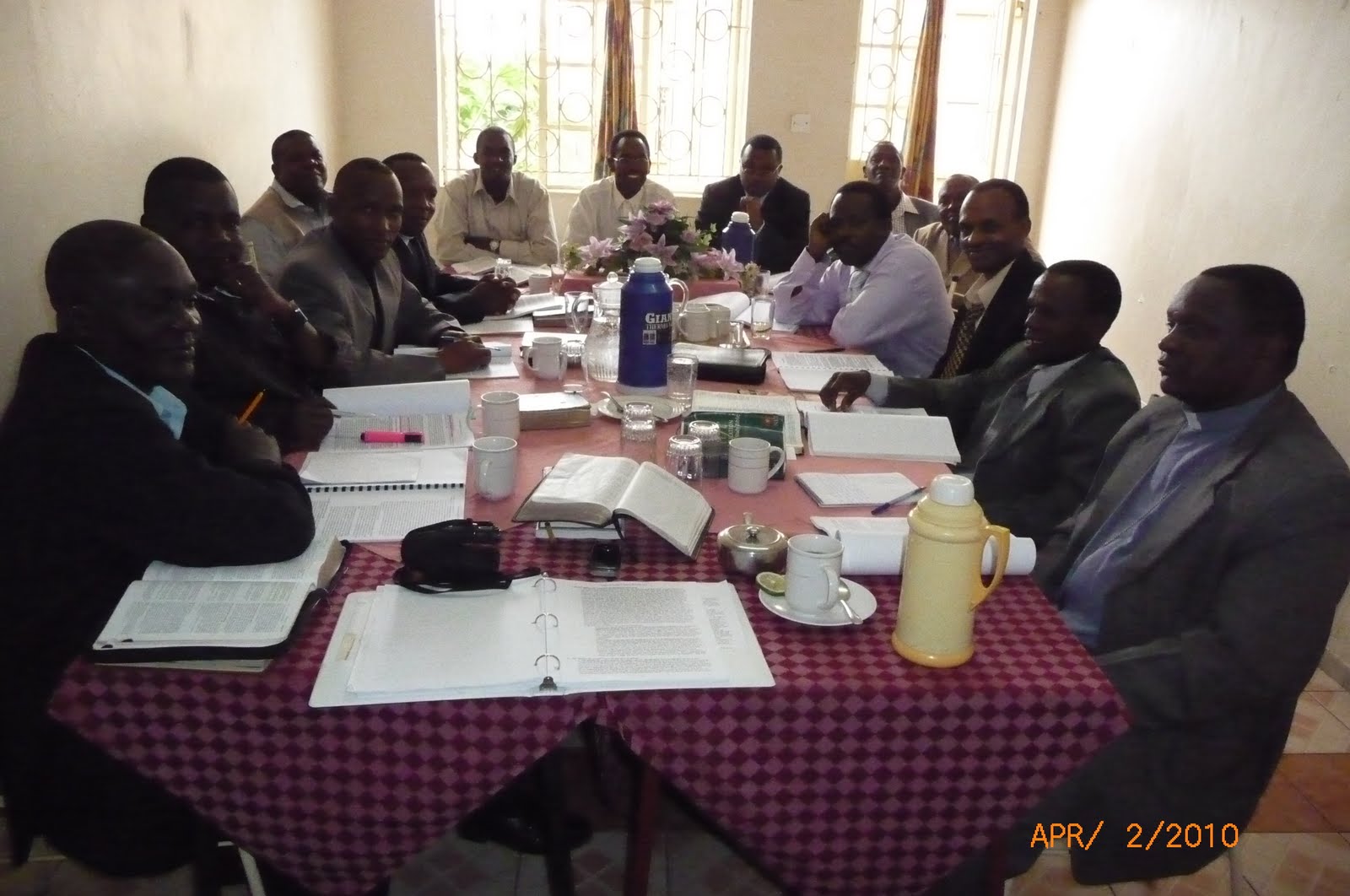
The flights from Appleton to Nairobi seemed particularly long this time, inasmuch as I had to leave the day after my daughter's wedding (the wedding itself was a beautiful outdoor wedding at Calumet County Park). George Kariuki met me at the airport. I was the recipient of typical African hospitality, as we were feasted at the home of George's brother-in-law Daniel and his wife Katherine, even though we didn't arrive there until about 10:30PM. Unfortunately, we had to leave early the next morning for the 8 hour bus ride (over horrible roads) to Arusha, Tanzania. In Arusha we conducted our first of two Biblical Stewardship TOTs. Although I generally insist that TOT participants be fluent in English (because TOTs are designed for smaller groups, and a premium is placed on discussion and Q&A), some of these participants were not too fluent in English. Consequently, we conducted the TOT in Kiswahili (I didn't, but we had a translator for me). As a result, I decided that George Kariuki should lead most of the sessions (in Kiswahili), which he did. George is an excellent teacher. All of the participants commented on how valuable this TOT was. Stewardship is one of our core courses, and essentially amounts to applying Christianity and biblical principles to most major areas of life (environment; time; mind; body; money and possessions; and the church). Applying this has the potential of profoundly changing lives. These TOT participants are now in the vanguard of changing people in the churches to a better way of living, which will affect not only the churches but Tanzanian culture.

We then travelled to the east coast of Tanzania, where we did another Stewardship TOT in Tanga, for pastors from both the Tanga area and from Zanzibar. Several of the pastors seemed quite moved by what they had discussed--especially the role that the church should be playing in the lives of the people. Three of the pastors said that, based on what they had learned, although their churches did not currently have formal budgets, they would now be adopting them (the Stewardship materials include information for both household and church budgets, including sample budget forms).

We are now in Dar es Salaam (the national capital) where we have just completed a pastors conference on 1 Timothy. Wilbert Seme and Joram Ibrahim, both Tanzanians, taught with me, and did excellent work. Although we have been in Dar previously, this was a new venue. This work is particularly important here in eastern Tanzania, since Muslims constitute the vast majority of the population here (about 85% in Tanga; 96% in Zanzibar). Consequently, the churches need to be equipped and strengthened so that they can work together and help to meet the important needs in this difficult part of the country.

Pastor Wilbert Seme has been coordinating our work throughout Tanzania. He has been doing a good job. However, he does not have high fluency in English. Having to work through a translator inhibits our ability to communicate well. I am happy to say that Joram Ibrahim of Tanga has agreed to be my Tanzania national contact person and will work with both Wilbert and me (Joram will act sort of as a CEO and Wilbert as a COO). They both will join me and the other national coordinators for a strategizing meeting in Kampala in October. This has been an answer to prayer. I think that, as a result of this trip, we will be able to put into place some good regional leaders throughout the northern half of Tanzania. Since Tanzania is the geographically largest country of East Africa, and has the highest Muslim population of East Africa, establishing a solid organizational foundation for EPI here is of great importance.

Tomorrow we take the lengthy bus trip to Dodoma, a regional capital and site of a large university. From there I plan to go to Singida and then to Kilifi, Kenya (just north of Mombasa, on the coast).

Monday, May 10, 2010

Greetings from Kenya: Part 2

South B slum (Nairobi, KE)--site of Biblical Stewardship conference Lucy Kariuki teaching in Webuye, KE

Karatina, KE conference

EPI-Kenya national leaders at TOT in Thika, KE

After a little more than a month in Kenya, I safely returned on May 1. I just made it back to Appleton three days ago, however, since I had to take care of a legal matter in Florida relating to my dad's estate, that had to be dealt with immediately upon my arrival back in the States. In fact, because of the Iceland volcano, Nancy had to re-book me on another flight through South Africa to insure that I would arrive back in the US in time to deal with the estate matter. That resulted in about 34 hours of flying and waiting in airports, but all went well.

The work in Kenya proved to be very worthwhile. As I had indicated in my report from the field, we have a very good group of Kenyan pastors who are committed to furthering EPI's work. I am hoping that we will be able to develop similar groups throughout the rest of East Africa, and then expand the size of the groups. To that end, I have already communicated with my national coordinators in Uganda, Rwanda, Burundi, and Tanzania. The national coordinators and I are planning on meeting together in Kampala, UG in mid-October to share ideas and strategize. This will be the first time at which all of the national coordinators and I will have been able to get together personally. Please pray for this meeting, as I think it will prove to be very important.
This trip to Kenya also was important in that, other than the two Expository Preaching conferences we did, at all of the other conferences anywhere from 3-5 Africans did the teaching along with me. I am happy to report that they were all good, and some were outstanding. Sometimes they spoke in English, other times in Kikuyu or Kiswahili. As I have frequently told the pastors in Africa, "You can teach this material better than I can, because you know the language, the people, and the culture better than I ever will." In fact, at the Biblical Marriage and Parenting conference we did in Webuye, Western Region, KE, although George Kariuki, James Ndiba, and I all taught various sessions, it was Lucy Kariuki who "stole the show." She is the only one of us who was given an actual present at the end. Further, the ladies of Webuye specifically invited her back for more! Thus, as I see it, this trip really marked a beginning of the African church leaders embracing "ownership" of EPI and its vision. The more EPI establishes some sort of ongoing, distinctly African organization, structure, or other presence in East Africa, the more effective it will be, and the greater will be its impact, long after I am gone. That is one of the basic things I am aiming to do.

All of this confirms my thoughts and observations over the past year or so: namely, I need to spend as much time as I can doing TOTs (i.e., providing more in-depth training to smaller groups, who can then go out and teach other pastors). Also, I need to provide more good written materials to the church leaders in East Africa, and facilitate translation into the most widely used East African languages. Right now, Biblical Stewardship has been translated into Kiswahili, and has been posted on our website. Translation of Biblical Stewardship into Luganda and Kirundi is in the proces of being finalized, as is Expository Preaching into Luganda. Translation of 1 Timothy into Kiswahili, Kinyarwanda, Kirundi, Ateso, Luganda, Ruyankole, and French is occurring right now. More will be following as soon as possible. I hope to get all of my materials translated into these and other important East Arican languages over the next two years.

While I was away, I received two donations specifically earmarked for the translation project. Those donors recognize the importance of translating solid, biblical material into indigenous African languages. It will have a direct impact on thousands, and will last for generations. You can be a part of this project. You can either make your tax-deductible donation through our website (www.equippingpastors.com) or can send a check payable to EPI, c/o Jonathan Menn, 714 S. Summit St., Appleton, WI 54914.

There are a couple of other exciting ventures which have the potential to significantly expand EPI's impact in East Africa. However, I will hold off on mentioning them until I see that they may actually come to fruition. Your prayers about all of these matters are most important. In my view, a ministry that essentially amounts to some Westerners going over to Africa and periodically holding conferences (and there are lots of such ministries) will basically have little or no impact, and is really not worth very much. On the other hand, to put in place sizable groups of committed, well-trained, and capable African teachers, who can draw on each other and who have excellent, theologically sound and practical written materials in their own languages to use and distribute to others--that is something worth striving for and will make a difference.

May God be with you and keep you, Jonathan

Greetings from Kenya: Part 1

Student preacher--Murang'a, KE Here comes the bride! Murang'a, KE

Kenya's EPI national leadership group--Thika, KE

I just returned from a month in Kenya. The following report from the field was sent to those on my email list while I was there. If you would like to be included on my email list, please email me at jonathanmenn@yahoo.com and request to be included:

Dear Friends and Supporters,

This is proving to be a very busy but fruitful time in Kenya. I began by having a Biblical Stewardship TOT (training of trainers) session in Thika, KE with 15 people who are leading EPI's work here. The Kenyans have done a tremendous job of organizing themselves to coordinate EPI's work here. They have elected a national coordinator and regional coordinators for the 8 regions of the country. Thus, the continuity of our work here does not depend just upon one man. Further, they all share the vision and are passionate about equipping the Kenyan pastors themselves. This is very encouraging to me. Kenya has come a long way since I began working here 3 years ago. The short-term and long-term prospects are very positive.

From Thika I traveled to Murang'a, in the Central Region. I was honored to preach at a wedding, and then again at the Easter Sunday church service. Kenyan weddings are social occasions where many people come, whether invited or not. Like funerals, they provide a good opportunity to present the gospel. Thus, I preached for about 40 minutes at he wedding and for an hour on Sunday. No one considers that a long time here.

We then conducted our first Expository Preaching conference in Murang'a. Much of preaching over here is the pastor taking a verse and using it to say whatever he wants to for about an hour on Sunday mornings. Consequently, we selected a group of just over 30 pastors who are fluent in English. The reason is that, after teaching about the nature of expository preaching, principles of effective sermons, reading and preaching in context, sermon organization, etc., we divided the participants into 3 small groups. Each group was assigned a passage of Scripture to preach (approximately 1/2 to 1 chapter). The small groups had a number of sessions during the conference to analyze the passage and work or preparing a sermon. On the final day, one representative from each group was given approximately 40 minutes to preach a sermon based on the passage, and apply what we had been talking about. The entire group then critiqued the sermons, both the good and the bad (and I, of course, had plenty to add).

The participants obviously learned much. Such things as employing a problem or issue-based introduction, a "proposition," and "organizational sentence," and specificity of application were largely new to most of them. The three sermons all showed promise. You may be interested to know that I would rank the woman preacher ahead of the two male preachers, if I were ranking them. All in all, I think the church will be deepened as a result of this. George Kariuki, my host (and EPI's Kenya national coordinator) demonstrated his understanding of good preaching by the comments he made to me while the others were preaching. They mirrored many of my own comments which I had written. That is heartening to me. Despite various cultural differences, there are some cross-cultural principles that, as they are applied, will lead to better Bible teaching and preaching--and thereby to a strengthening of the churches in East Africa.

I am now in Karatina where we are doing a conference on Biblical Stewardship. This conference is a first in that 5 African leaders (George Kariuki and 4 of the regional leaders who had gone through Stewardship TOT) will be teaching with me. That is exactly what I want to see happen: the Africans themselves doing more and more of the teaching. In George's session, he was able to stimulate a lot of Q&A and discussion. That, again, is "music to my ears."

After Karatina comes a week in Nairobi for Expository Preaching and Stewardship, and then to the Rift Valley and Western Kenya for Biblical Marriage and Parenting and 1 Timothy. Thank you for your prayers and support. Your prayers and financial support make this all possible. In that regard, I just got an email that the Kiswahili translation of the Expository Preaching course materials is now being finalized!

Best regards to you all, Jonathan

Wednesday, March 17, 2010

Leaving for Kenya

This has been a busy and productive time at home. When I was home in November-December I spent most of my time finishing my materials on Biblical Theology. This last month I finished revising my materials on 1 Timothy. We now have a detailed outline, 45 page commentary, and the Inductive Training Manual all in one volume of about 70 pages. This has been sent to Africa, to be translated into a number of East African languages. If you are interested in reading or downloading any of our written materials, please go to our website (http://www.equippingpastors.com/) and click on "Resources," which will take you to our Resources page. We have subpages of documents in various African languages. These pages are all being added to on a regular basis as we develop new course materials, and as our resources are translated into the various African languages.

It generally costs between $250-500 to translate one set of course notes into one African language. I have to pay that cost myself. There are very few good theological materials in indigenous African languages. As we get these materials translated, printed, and into the hands of the African church leaders, I think that they will have a significant and long-lasting impact. You can help this project by sending your tax-deductible check, payable to EPI, to me at 714 S. Summit St., Appleton, WI 54914. Or, you can donate online (see our website). Please think and pray about this. By giving a relatively small amount of money by our standards, you will be affecting the lives of thousands for years to come.

On March 24 Nancy and I will be driving to NYC to see our daughter Julia who is going to school there. Then on March 29, as Nancy drives back home, I will fly to Nairobi. I will be in Kenya the entire month of April (I'm scheduled to arrive back home on May 1). We are planning on a full and varied program: Stewardship TOT; and conferences on Expository Preaching, Biblical Stewardship; Marriage & Parenting, and 1 Timothy.

Thank you for your prayers and support. I will, as always, try to send those on my email list a report from the field. If you would like to be on my email list, please email me to that effect at jonathanmenn@yahoo.com. Take care, Jonathan

Thursday, February 18, 2010

Return from Burundi and Rwanda

David Lewis teaching at Gahanga, RW Graduates of Bible School at Muyinga, BU refugee camp
Alan McClue and colleague at Ntarama genocide site
Jonathan at Nyamata genocide site

Here is the rest of the story from Burundi and Rwanda. The trip itself went well (thank you for your prayers!), although for much of it I was quite tired (perhaps because Nancy and I had driven about 22 hours from Orlando to Appleton the day before I left).
Following the conference in Muyinga, BU (which I mentioned in my report from the field) Theophile and I travelled to Rwanda, where we held three conferences, all of 1 Timothy: one in Gahanga (not far from the capital of Kigali), one in Kigali, and one in Ruhengeri to the north (the area of volcanoes, where the gorillas live).
My friend, David Lewis, joined us for the Gahanga and Kigali conferences, and taught at each one. David had previously been to southern Africa many years ago, but had never been to Rwanda. As is true for virtually everyone who comes there, he was very impressed with the country and its people. We made sure to visit two genocide sites, and had the good fortune to meet W. Alan McClue, a forensic pathologist from the UK who was there for a conference. That gentleman had been part of the investigation into the shooting down of President Habyarimana's airplane (now proven beyond a doubt to have been done by Hutu-power extremists within his own government as a pretext to begin the genocide). He also had been to the Ntarama genocide site (where we talked) about 8 years after the genocide when the bodies of many of the 5,000 victims at that site were still lying there. In one room (where victims were burned to death) you still walk over bits of bone and teeth.
This trip was very important in that I met men who expressed the desire (and appear to have the ability) to translate our materials into Kirundi (the dialect of Burundi) and into French (spoken throughout Rwanda, Burundi, and Congo). I also talked at length with Theophile about plans for the future. He is a good, well-trained, competent, and committed man. He has planted 41 churches, founded more than one Bible school (including one in a refugee camp, where I was honored to attend the graduation ceremony for the first graduating class), and has many good contacts through out the region. I see the hand of God putting us together for the important work of equipping the pastors and church leaders of the East African churches.
The translation of our notes is vital. I believe that, as we get our materials translated into the important languages of East Africa and into the hands of the East African church leaders, the effects over time can be profound. Some indication of the impact may be gauged by these comments from the man who is translating our materials into Luganda (a major language in Uganda): "Brother Jonathan, thank you for writing this book [Expository Preaching]. It is a book every faithful preacher and shepherd of God's flock should study and study and internalize. During the time of its translation, it has added very much to what I already know as a pastor and preacher of God's Word. And it will be a great joy for me to teach it to brothers in Christ wherever the Lord will have sent us to minister to them. It is the material we really need." And "I have just finished translating page 27 of Biblical Stewardship. But wow, I am learning great things. Thank you for writing these books."
It will cost between about $250-$500 to translate one of our sets of notes into one African language (depending on length and other factors). I currently have notes for 8 courses, and there are about 8 languages into which I would like the notes to be translated. As you can see, the total project (and I will be developing more courses) will end up costing several thousand dollars. Your tax-deductible donations to EPI will pay huge dividends for a very long time. Currently, very little good theological material is available for the East African churches in languages other than English (and some in French). Please think and pray about this. You can give online through or website (http://www.equippingpastors.com/) or can send a check, payable to EPI, to me at 714 S. Summit St., Appleton, WI 54914.
My next trip will last a month, from the end of March to the end of April, and will be spent in Kenya. I will update you further at that time.

Report from Burundi and Rwanda

One form of "public transportation" in Burundi
Burundian cultural drummers

Teaching at conference in Bujumbura, BU

Less than a week ago I returned from Burundi and Rwanda. This was the report I emailed to friends and supporters while I was still there. If you are not on my email list, but would like to be, please email me, and I will add you to the list so that you can get reports from the field when I am overseas.

Burundi is warm--in the 80s--and beautiful. Theophile Rugubira, EPI's Rwanda-Burundi coordinator, and I have done 2 conferences in the capital of Bujumbura. One was on Biblical Stewardship and the second on 1 Timothy. The people have been very receptive. The second group were people with whom we have not interacted before. Most of the pastors have NO training at all. It makes me very sad. However, they appear committed to do what they can with the new knowledge they have. Please pray for the churches in East Africa. They face huge problems, and have little training or resources. It is an honor to work with them.

I preached in the church of pastor Francois on Sunday. Afterwards he took me to Lake Tanganyika--one of Africa's "great lakes" and the deepest. A hippo was not far off shore. Not like back in Wisconsin at this time of the year!

I am now in the eastern city of Muyinga, not far from the Tanzania border. We are in the middle of a conference on Biblical Stewardship. I have been informed that this is the only internet cafe in the entire city. The connection comes from Nairobi, Kenya, and is incredibly slow. Additionally, the keyboard is not configured as are our keyboards back home. Oh well.

The people here likewise have had NO prior training. I have heard many times that even such basic (to us) information such as "our bodies are the temple of the Holy Spirit, and we therefore should take care of them and bathe," and "your spouse should have precedence over your job," is "new," and "we have never heard this before." On the other hand, during small group discussions, all of the groups seemed enthusiastic about beginning the process of teaching their people how to do basic budgeting, and beginning to budget and keep records in their churches, as well as apply some of the other things we have been teaching. I was very distressed, however, to see that most of the pastors here are in the thrall of heretical "prosperity" teachers. I sensed great resistance as I was talking about that. Theophile pointed out, though, that they had never heard the orthodox Christian position on that issue. Naturally, they would be resistant. However, we have supplied them with an excellent written critique of the "prosperity gospel" in their own language. Theophile will be returning here in 3 months to follow-up with the participants. God-willing, by then they will have read, checked out what we have said with the Scriptures, and may have changed their views to a more biblical one.

Please pray for these dear pastors and church leaders. Their needs--spiritual and otherwise--are so great, and their resources are so few. Thank you for your prayers and financial support of this ministry.