Sunday, April 7, 2013

Report from Rwanda and Burundi

In January and February I spent three weeks in Rwanda and Burundi, mostly in Burundi. I inadvertently neglected to update this blog, so here is my report on that trip now (BTW, I am leaving for Kenya at the end of this week):
                                                        Expository Preaching class
                                                          Devastated central market
                                                          Frederic Harerimana teaching
                                                        Nestor Bukuru and his church

Expository Preaching
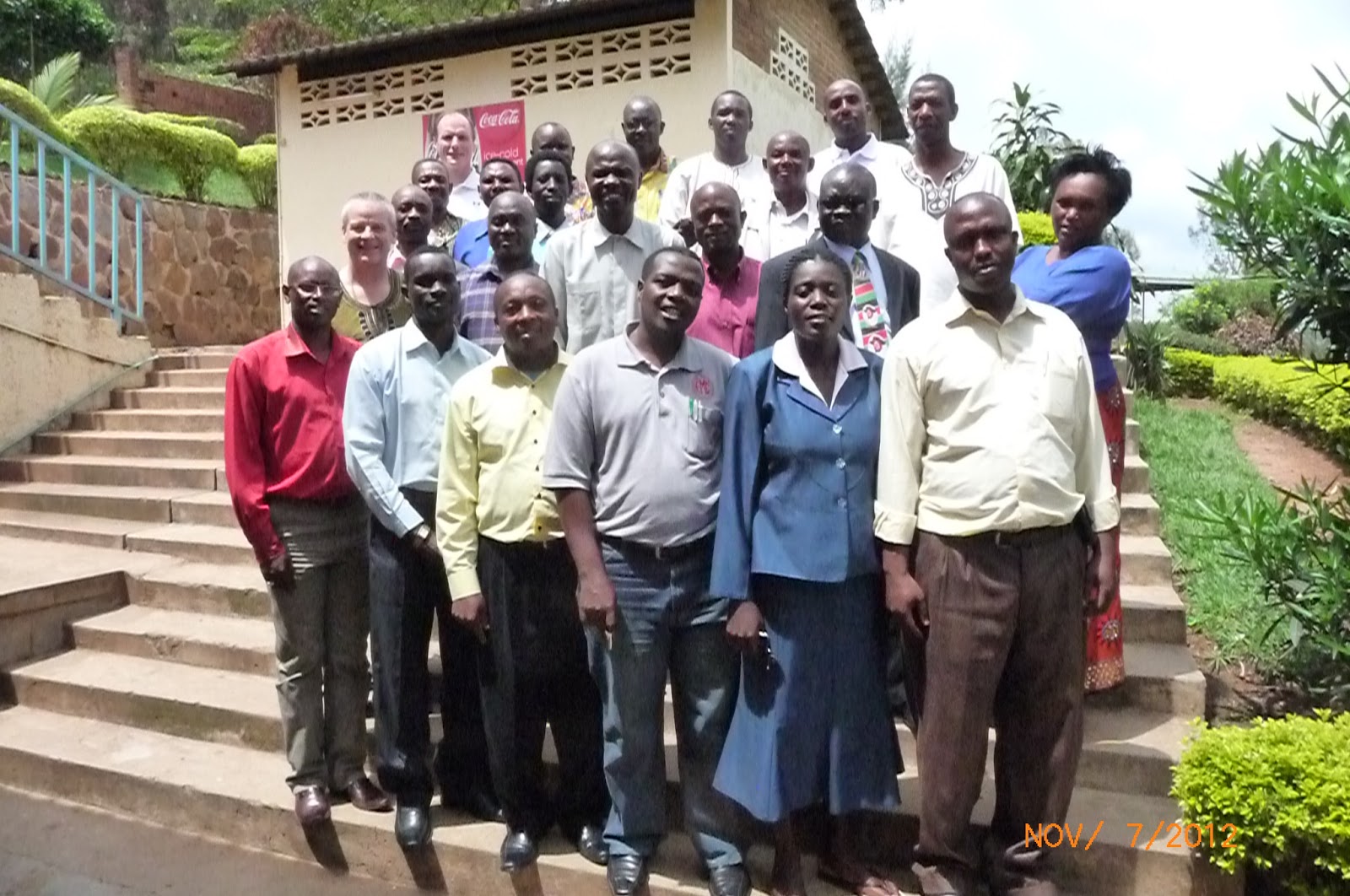
We did round 3 of expository preaching in Kigali, Rwanda with 14 students. Actually, it was round 3 for some, but about half of the students were new, so it was round 1 for them. It demonstrated the importance of doing this more than once. One round 3 student said, "Now it is all clear." We focused on two passages: Ezek 36:22-32 and John 7:37-39. The preaching and critiques are always a highlight. We divided into two groups for the preaching: I took one and Theophile Rugubira took the other. All of the preachers in my group were new, so many of them fell back into the old ways much of the time, but the critiques were helpful. Fortunately, we had sufficient time for me to preach one of the passages, so they were able to see exactly what I was advocating. That proved illuminating. Also, the students themselves expressed the desire to get together every two months or so for preaching and critiques on their own, in their own primary language. That will facilitate learning and understanding, since in most cases English is their third language.

Bujumbura, Burundi   
I took the 6 1/2 hour bus ride to Bujumbura, the capital of Burundi, located at the top of Lake Tanganyika, the deepest lake in Africa. Here it is Florida-like: mid-80s and lots of semi-tropical vegetation. At the African leaders strategic planning summit in Kigali last November, I had talked about the importance of setting up indigenous committees/structures in each of the East African countries, for accountability and continuity purposes. The Burundians have done that. Frederic Harerimana is the chairman, along with Francois Sebagabo, Venat Bagabo, Nestor Bukuru, and Bonaventure Haringazi. We want to do things right here.

We will be doing three 1 Timothy conferences and one TOT, all in suburbs of Bujumbura. We have just finished the first conference, with about 20 participants. It went very well. Frederic did translating for me and taught three of the units. Venat and Nestor also taught. The bishop of Eglise Emmanueliste du Reveil Church hosted. He is an enthusiastic proponent of what we teach (he has been a participant in the past) and gave a testimony concerning the impact that the teachings have had on him and his people. I also preached in his church last Sunday.

A Tragic Loss    
About a week ago the central market in Bujumbura was burned to the ground. It appears to have been a well-planned arson. It has not yet been announced who is responsible. This is a terrible tragedy, especially for such a small country as Burundi. I was informed that the central market was home to countless small businesses, did the equivalent of about $5 million in business each day, and that about 5000 people worked there. Everybody and everything was totally wiped out. There were also a few deaths. In addition to the great personal losses, this will have significant economic repercussions throughout the country and for the country' s economy. Please pray for the people and peace of Burundi.

 Kanyosha and GatumbaWe did two 1 Timothy conferences in the Bujumbura suburbs of Kanyosha and Gatumba, before about 47 participants. Venant Bagabo, Nestor Bukuru, Frederic Harerimana, and Francois Sebagabo taught along with me. Developing good African teachers is particularly important in a country like Burundi where very few people speak English (the national language is Kirundi). The conferences went well. At the conclusion of the Kanyosha conference one of the pastors, Samuel, told us how my discussion of the so-called "prosperity gospel" in connection with 1 Timothy 6 had spoken very directly to him. He had been told by a "prosperity teacher" some years ago that if he continued to preach and teach the gospel as he was doing, he would never be able to live in a big house in an affluent neighborhood of Bujumbura. I am happy to say--and he is happy to say--that he has remained faithful to the real gospel of Jesus Christ and now sees from the exposition of the Scripture why that is so vitally important.

TOT in Bujumbura
We conducted a TOT on 1 Timothy for 15 participants at Francois' church in Bujumbura. Since 1 Timothy is written primarily to leaders, its impact on individual church leaders is always front-and-center at the pastors conferences. However, at this TOT, our discussions brought home to me, in a way I had not appreciated before, how the entire book is challenging the churches in order to get the leaders to ask themselves and reevaluate how they "do church" and why they do things the way they do. Specifically, what does the "church as a family" (1 Tim 3:15; 5:1-2) and "church as pillar and support of the truth" (1 Tim 3:15) imply for how we do church, our priorities, and what we focus on?

We talked about many issues along these lines. Sometimes the discussions became quite animated, and at times they spent some time debating in Kirundi rather than English. All this is good, and I hope that some of the pastors saw a little bit about how bound many of us are to our own traditions, and also saw the great potential the churches have for making a real difference in their people's lives and in society if changes are made. This is particularly important given the burning of the central market and the financial devastation that resulted to many people. The churches, despite their own relative poverty, should play a prime role in restoration.

Final Thoughts
There has still been no announcement concerning who is responsible for the fire. Please pray for Burundi and for the revival and re-prioritizing of the churches. I preached at Nestor Bukuru's church (the walls of which are made of papyrus reeds). My Burundi leaders will be developing a strategic plan for our work in that country. I probably will return to Burundi in the late summer. It appears that we will have the opportunity to do five days with all of the pastors of a particular denomination at that time. So, there is potential that we can make a significant difference in this beautiful and challenging land.

Thank you for your prayers and financial support. I will keep you advised of developments. God bless you, Jonathan

Saturday, November 10, 2012

Return from East Africa

 Baboon by the road in Tanzania
 Jonathan bringing Stanley and Livingstone together in Ujiji, TZ
 Leaders' meeting participants in Kigali, RW

Two days ago I returned from East Africa. The following is a synopsis of the last part of the trip.

Katoro and Mwanza, TZ
We did biblical stewardship conferences in Katoro and Mwanza, TZ.  Katoro struck me (and the rest of my crew [Dickson Laizer, Joram Ibrahim, and Godfrey Ongiri]) as spiritually "hard ground." We had not been to Katoro before. It was hot, dry, dusty, and dirty. We did have fish soup for breakfast at what appeared to be the one OK restaurant in that town (Mama Nasoro's). I thought it was somewhat discouraging, and the pastors all seemed to be a a very low level.Godfrey Ongiri will follow-up, so I hope that good will come of it.

Mwanza, which is located on the southern end of Lake Victoria, was also somewhat discouraging. It did not seem to have been particularly well organized. There were only about 32 participants at the stewardship conference, and the majority of them were not pastors (but were elders, deacons, worship leaders, wives, and others). The teaching went well. Godfrey is from Mwanza, so should be able to follow-up fairly easily.

Kigoma, TZ
The situation was considerably different in Kigoma. The stewardship conference was well organized. In Kigoma there is a good inter-denominational pastors fellowship--so we had pastors and leaders from all denominations, Pentecostal and non-Pentecostal. There were even a few Roman Catholics. We had over 75 participants, and they purchased about 90 of the Biblical Stewardship books. This group was enthusiastic, asked lots of questions, and appeared to learn a lot. It is an area I certainly want to return to. 

Kigoma itself is located on the shore of Lake Tanganyika. It used to be the transit point for the Muslim slave trade. The Muslims (who have enslaved far more people than Westerners ever did) would kidnap the Africans from central Africa and force them to march across the continent to the east coast, where they would then be shipped to the Middle East and other points. Kigoma has a very high Muslim population. I had not realized it, but Ujiji (just outside of Kigoma) is the place where Stanley met Livingstone and uttered the famous line, "Dr. Livingstone, I presume." On our last day there we visited the site where that occurred.

Kigali, RW
This trip ended with an important meeting in Kigali, RW of top people from all of the countries of  East Africa with whom I work. Dr. Frank Cummings led a two-day strategic planning summit meeting. We even had three representatives from the newest country in the world, the Republic of South Sudan. Most of the participants never had attended a strategic planning summit before. We focused on our mission and vision, our strengths and weakness, and ended by developing the beginning of an action plan. This was designed, in part, to help the Africans to develop a sense of "ownership" of this mission.

The meeting was successful. I just received an email from Ernest Mwilitsa of Kenya. He echoes the sentiments that others who were at the meeting also expressed:

>>We thank God for using you to give us that good opportunity to meet our fellow labourers in the Lord. Matters discussed were very important to us and the future of EPI. It is our prayer that we continue to have such meetings every year.

From the look of things, that is a real milestone and road map to our future.I believe with such exposure many people will work hard to make EPI a success. You might not know the impact of EPI in East Africa,
but I want to assure you that it has transformed many ministries.<<

Back Home
I have much work to do now that I am home. Frank is on his way back home even as I write this (he led a two day advanced biblical counseling workshop in Kigali after the summit meeting ended). Later in the year I will post a year-end summary. God bless you all.


Field Report from East Africa


Kitui, KE conference participants
 TOT in Eldoret, KE
 

 The following is the report I sent from the field while I was in East Africa recently:

I am now in Tanzania in the process of doing four conferences on biblical stewardship. Next up will be an important meeting in Kigali, Rwanda, of about 25 leaders from all over East Africa, including Southern Sudan.

Kitui and Eldoret, KenyaI began this trip in Kitui, KE, about 200km east of Nairobi. I had never been there before, but the groundwork had been laid by good all-African teachers. That, of course, points up the importance of equipping the indigenous pastors and church leaders, so that they can teach this material well to others.

George Kariuki, Robert Mwago, and I did a biblical stewardship conference to about 36 participants. The number was fewer than had been anticipated, primarily because it is planting season in Kitui. The fact that such seasons may vary slightly from area to area even in the same country is something we need to take into account in scheduling.

The conference itself went well. We were transported and assisted by Bishop Nicholas Mulea. The host pastor, Rev. Syslvester Kiema, is part of an inter-denominational pastors fellowship that includes several of the participants. He encouraged me by saying that they would be meeting to discuss how to implement what we had talked about in the conference. That is vital.

From Kitui we took the long bus ride to Eldoret in western Kenya. There, George, Bob Mwangi, and Dickson Laizer and Joram Ibrahim of Tanzania all taught a biblical stewardship conference, while I led a 1 Timothy TOT for about 14 pastors. We had spirited discussions on a host of important issues facing the church. We raised issues that generally are not thought about too much. People were challenged. I think it will make a difference. I hope so, because in my view the church, as the embodiment of the gospel, is the last, best (and only real) hope for humanity and our different societies. But to realize that hope, the church needs to change and start applying the gospel in ways that it clearly is not doing now.

Musoma, TanzaniaMusoma, along with my other Tanzanian venues, is near Lake Victoria. As I write this, we have finished a stewardship conference with 30 serious and committed pastors and an important bishop. They were challenged in many areas, and I think all see the need for change and for much greater involvement of the church in "real life."

Please pray for them. I am now in Mwanza, TZ. We have a 3-hour trip early in the morning to our next venue. Also, please pray for the strategic-planning summit coming up in Kigali in less than 2 weeks. I will report again after my return home. God bless you, Jonathan

Thursday, July 12, 2012

Report from Tanzania


TOT group in Dar es Salaam, TZ
 Queueing for lunch in Chamwino, TZ
 Randy Pizzino teaching in Magugu, TZ


The following is the report I emailed from Tanzania during my recent trip to East Africa:

Greetings from Tanzania. It has been a good trip so far. Began with a 1 Timothy conference in Magugu, between Arusha and Babati. I was joined by EPI's new full-time staff member, Randy Pizzino. Randy was a pastor for 41 years before joining EPI. He taught well, and also experienced the joys of eating copious amounts of pili-pili!
    
Chamwino.
Randy left us after the Magugu conference to return to Nairobi, from which he would be going to Uganda. I took the 6-7 hour bus ride to the central TZ city of Dodoma, one of the seats of the government. From there we went to the nearby village of Chamwino, which is also the site of government offices, and thus a strategic place. We held another 1 Timothy conference. After the small group discussion time, which focused on the issue of the church as a family, the participants were so moved and convicted that they had a spontaneous time of repentance before God. They also firmly resolved to form an inter-denominational pastors' fellowship, and begin working together in practical ways to show the love of Christ within their community. This could bear great fruit in the future, particularly as the government spends more time in the Dodoma-Chamwino area, and sees real Christian fellowship and concerted, loving action.

Dar es Salaam. We arrived in the coastal port city/national captial of Dar es Salaam for an TOT on Biblical Theology. The participants are seeing the connections between the OT and the NT, the fascinating ways in which the OT pointed forward to Christ, and how the NT fulfilled the entire OT, often in surprising ways. My friend and EPI-TZ coordinator Joram Ibrahim remarked at how powerful this is (and I agree). 
 
Dickson Laizer.
One of the issues I have had to deal with is the organization of EPI here in TZ. One of my co-national coordinators was not fluent in English, which prevented me from communicating well with him. Consequently, I asked Dickson Laizer, Secretary-General of Grace Evangelical Church to be the EPI-TZ national coordinator. Dickson is a good man, experienced in teaching leaders, with a passion to do so and a true pastoral heart. I think he is God's answer to this situation. Randy recognized that this was a good choice, and I just received an email from one of the other TZ coordinators to the same effect. Knowing Dickson as I do, I think he will be able to work well with the others in the TZ leadership team, and help move EPI forward in TZ. I am looking forward to the future here, as the Tanzanians are getting well-organized, with some good and competent people.

Zanzibar. I am now in Zanzibar in the middle of a marriage conference. I pray for God's blessings on you, and will report back to you after I return home in mid-July. Best regards, Jonathan

Friday, April 27, 2012

Return from Kenya


Pastor Joseph and church members in Siakago, KE


Forgiveness and Reconciliation TOT group in Murang'a, KE


Student preaching in Murang'a, KE


JMM and EPI-Kenya coordinators

I returned from Kenya two days ago. This trip concluded very successfully, and important steps were taken organizationally for EPI in Kenya, which I hope can be replicated in the rest of East Africa.


The Biblical Stewardship TOT in Embu was very powerful. One woman, who has both money and connections, wants to facilitate implementation of the things we discussed. The group as a whole demonstrated their seriousness by agreeing on a date and time to re-gather to discuss how they can work together to apply what they learned. This type of commitment and action is what I long to see all over East Africa. I then preached on Sunday at a growing church in Siakago, near Embu.

In Murang'a we did both Forgiveness & Reconciliation and Expository Preaching. As had been the case in Nairobi, some of the stories told by the Forgiveness participants were heartbreaking. Nevertheless, the Holy Spirit brings healing in amazing ways. The material we discussed enables the pastors not only to forgive and bring reconciliation in their own lives, but also to show and teach their people. Bob Mwangi, one of EPI-Kenya's regional coordinators, discussed with me his plans to convene an inter-tribal Forgiveness & Reconciliation TOT prior to the upcoming national elections. This type of endeavor is being called for by the government, as a way to help prevent a recurrence of post-election violence. Thus, all of the participants recognized how strategic and timely EPI's work concerning Forgiveness & Reconciliation is.

The Expository Preaching TOT is also bearing fruit. The preaching by the four student preachers was better overall than I have seen in most Expository Preaching TOTs; they all incorporated some or all of the important concepts that I have been emphasizing. One of the participants, who had not preached in class, preached Ezek 37:15-28 (one of the texts we had worked on) in his church the following Sunday. He told me that afterwards people came up to him and complimented him on how focused and powerful his sermon was. That was encouraging to him (and to me). I listened to George Kariuki preach at the first service in his church on Sunday. He obviously understands what we are talking about, and preached a fine sermon (I preached at the sencond service).

Because KLM had cancelled my return flight and rebooked me to leave a day earlier than I originally had planned, I cancelled the last TOT I was going to do (Bob Mwangi and George Kariuki will themselves lead it). Instead, I met in Nairobi with all of my EPI-Kenya coordinators. We discussed financial matters, accountability, transparency, and structural issues. We came up with a more systematic financial plan for compensating the Kenyan teachers and coordinators for their time and work. We also established financial oversight committees, both regionally and nationally. Thus, EPI in Kenya now has a structure that is both sound and not dependent on any specific individuals. The Kenyans then met and mapped out a host of all-African conferences they plan on doing this year. What they intend is that they will do the conferences and, when I come to Kenya, I will concentrate on doing TOTs with the really sharp people they identify at their conferences. That is exactly what I think will maximize both my time and EPI's impact.

Finally, I met with the representatives of a printing company in Murang'a, and discussed printing our materials in paperback book format, rather than photocopying them as we have been doing. Printed books will, of course, look better, last longer, can be stored more easily on bookshelves, etc. The books also can be fairly easily transported throughout Kenya and to other East African countries. I think printing and shipping can be done cost-effectively. I am excited about the possibilities, as this also should increase our effectiveness and impact in Kenya and the rest of East Africa.

Thank you for your prayers and support. You ARE making a difference. God bless you, Jonathan

Greetings from Kenya


Preaching in Malaba (note the fancy pulpit)

                                                                        Biblical Stewardship TOT group in Misikhu

                                                               Forgiveness and Reconciliaton TOT group in Nairobi

The following was the report from the field I recently sent from Kenya:

I am here in Kenya, and have been doing all TOTs. They have been productive and interesting. We began in Malaba, on the border with Uganda, doing another round of Expository Preaching with selected members of the Katakwa Diocese of the Anglican Church of Kenya. Isabellah Inyele, my coordinator in that region, is one of the most competent, organized people I know. She is also an excellent preacher. The group seemed to be learning the preaching format I have been suggesting. The critiques of the sermons we preached were particularly helpful. In fact, the students' critique of my sermon on Ezekiel 37:15-28 caused me to make some revisions, deletions, and change the order of certain things. One pastor suggested that I return and that we do nothing but preaching and critiques, so that everyone gets a chance to preach and be critiqued. I think that is a good idea.

We then moved to Misikhu, about an hour inland, for a TOT on Biblical Stewardship. One pastor commented, "Your teaching is not like the Whites. They came to steal our blessings." Another added, "This is foundational. This can change Africa." I think (and very much hope) that he is correct.

Following Misikhu I took the long bus ride down to Nairobi. The trip was complicated by the fact that about 2/3 of the way through, the bus broke down, and we sat for 1 1/2-2 hours until my group was picked up by another bus.

In Nairobi we did a TOT on Forgiveness & Reconciliation. This proved to be very powerful. Many of the pastors shared some very deep wounds. Some had lost everything in the post-election violence of 2007-2008. Others had other, very damaging experiences. Yet they all talked of their being able to forgive the perpetrators and find healing. One woman said that she had come sick at heart to the TOT and had remained that way for the first 2 day. By the end, however, she had felt healed and empowered, and committed to go to the person with whom she had a significant problem and reconcile.

One of the organizers told me that several people had come up to him during lunch and shared how healing the whole TOT had been. The organizers are going to follow-up and will be leading this seminar themselves in various places. Forgiveness & Reconciliation is particularly important, not only in light of the recent post-election violence, but also given the fact that Kenya will be having general elections again at the end of 2012 or beginning of 2013. There has been lots of talk in the media here about increased tribalism in connection with the upcoming elections. Please pray for Kenya and this whole situation. The Gospel, when believed and applied in our lives, truly changes and heals people, and is the deepest and best way to avoid a repetition of the troubles our Kenyan friends have experienced.

I am now in Eastern and Central Kenya, doing a Biblical Stewardship TOT, to be followed by Forgiveness & Reconciliation and then Expository Preaching. Because my return flight was canceled and moved up one day, I have decided to cancel the final 1 Timothy TOT and instead meet with all my Kenya EPI coordinators in Nairobi. We need to discuss financial, budgeting, accountability and structural matters. This will, I think, be very important as we move forward. Please pray for this. God bless you all.

Saturday, March 24, 2012

Jonathan leaving for Kenya on March 30

My time at home has flown by. Since I returned home just over a month ago I have completed some major additions to my notes on Biblical Theology (the equivalent of approximately 25 pages of new material, including three new appendices: the Bible in chronological order; Jesus as fully God and fully man; and Jesus and the sign of the prophet Jonah). I also finished revisions to Biblical Eschatology (equivalent to about four pages of new material). Between these two books alone, I think that you will have a very good understanding of the biblical storyline, and how the Bible fits together, from beginning to end. Check them out on the "resources" page of EPI's website: www.equippingpastors.com.

I have also been proofing a number of translations in Kiswahili, Kikuyu, Kamba, Luo, and Maasai that I have received. As the final edits are made, I will post them in the "African Languages Resources" section of EPI's resources.

You might be interested to know that Theophile Rugubira, EPI's Rwanda-Burundi national coordinator, has begun a weekly radio program in which he is teaching through EPI's course on Biblical Stewardship, will field questions from listeners, and discuss our material with local pastors. This is an opportunity to potentially reach well over a million people each week. We chose Biblical Stewardship because that course essentially concerns applying biblical pinciples to all areas of life. It is very practical, and thus I expect it will have a wide appeal.

I will be leaving on March 30 for 3 1/2 weeks in Kenya. While there I am planning on doing 7 TOTs (trianing of trainers), as follows: April 2-4, Katakwa Diocese-Expository Preaching; April 5-7, Western Region-Biblical Stewardship; April 9-11, Nairobi-Forgiveness & Reconciliation; April 12-14, Eastern Region-Biblical Stewardship; April 16-18, Central Region-Forgiveness & Reconciliation; April 19-21, Central Region-1 Timothy; April 22-24, Murang'a-Expository Preaching.

As always, I will try to send you a report from the field while I am there. Thank you for your prayers and support. Both matter, and both make a difference.