Friday, November 18, 2011

Return from East Africa

Expository preaching clasws in Arusha, TZ

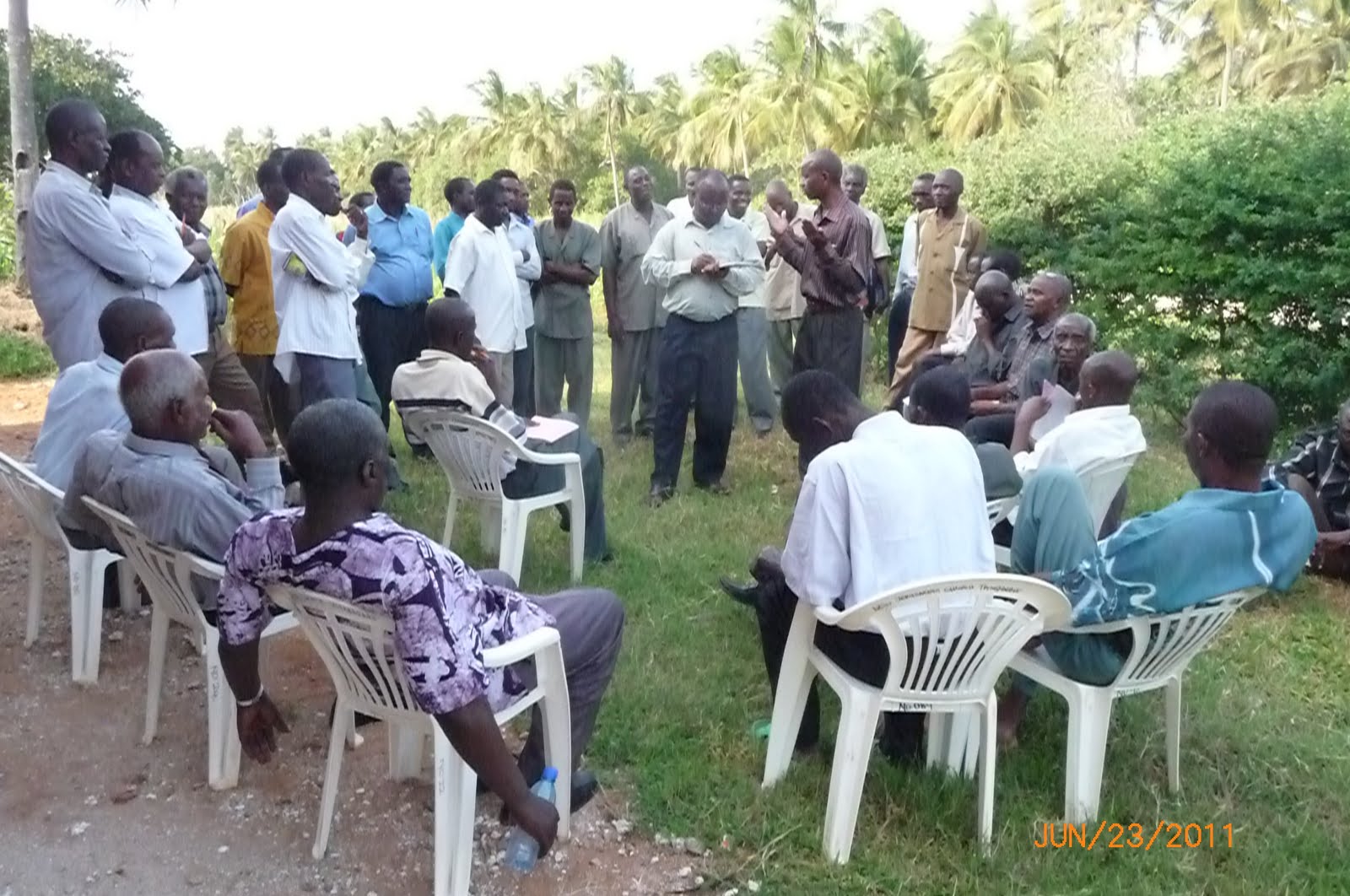
Husbands' small group discussion in Nyeri, KE

EPI-Kenya leadership team

A Tragic Occurrence

Following our conference in Mwanza, TZ, Joram, Wilbert, and I took the 8-hour bus ride to Singida, TZ. Unfortunately, a tragedy occurred on the way. Apparently a boy was running across the highway, looking behind himself. The bus driver slammed on the brakes and jerked the wheel sharply to the left, but the corner of the bus hit the boy, killing him. That necessitated a 3 hour wait while the police were called, a bus inspector had to come, and a new driver had to be obtained. As I reflect on it, I have been involved in more than one accident or near accident, and have seen the immediate aftermath of more than one fatal accident, since coming here to Africa. What happened to the boy demonstrates ultimately the most important reason for turning from our self-centered ways (which the Bible indicates amount to idolatry) and receiving Christ as our Lord. That boy did not wake up and say to himself, "Today is the last day of my life." When he began to cross the highway he did not think, "I only have 3 seconds to live." Likewise, our death could come unexpectedly at any time, but then we face the judgment which will seal our eternal fate and destination. Christ alone can guarantee us eternal life rather than what the Bible calls the "second death." Given the incredible, everlasting stakes, to not seriously consider this and check it out evidences amazing blindness and hardness. Please don't be blind and hard.

Singida, TZ

In Singida we did Biblical Stewardship for about 60 pastors. During their small group discussion time, they were asked to talk about everything we taught up until that point: stewardship of the environment, of mind, time, body, and money and possessions, and focus on only 1 or 2 things that they thought were important and that they would apply back in their churches. One of the pastors suggested that I appoint different topics to each of the groups. I said that I wanted them to have the freedom to talk about whatever they wanted to and that, if they all ended up talking about the same thing, that would probably be the Holy Spirit trying to tell them something. Interestingly, all 3 groups focused on time management as the biggest problem which they had to address. We will see what comes of that!

Kateshi, TZ

We then went to Kateshi, about 2 1/2 hours outside of the city of Babati. Kateshi is hot, dry, dusty, and quite desolate. However, we had a good group of about 50 pastors, some of whom had come from more than 20 kilometers away to attend the 1 Timothy conference. Only 1 or 2 had ever studied an entire book of the Bible section-by-section from beginning to end before--and none had ever preached a series of sermons through a book of the Bible before. It proved to be a valuable learning experience. We received many questions, again centering a lot on polygamy. That is one reason I am glad that I have good Africans teaching with me, since they know the culture, speak the language, and can deal with many of the local concerns in a better way than I can.

Arusha, TZ

From Kateshi we took a 6 hour bus ride back to the "civilization" of the large city of Arusha, where I led an expository preaching workshop for 12 English-fluent pastors, and George Kariuki led a similar workshop for about 20 pastors who were not fluent in English. As has proven to be true in the past, the concepts and format of preaching that I was teaching the pastors were new. Old habits die hard (as the student preachers proved), but the critiques indicate both openness and learning. God-willing, I will return for "round 2" of expository preaching next year. Following the preaching workshop, all of the Tanzanians who were present (who constitute most of the Tanzanian EPI leaders) were to meet for a day to discuss organization, strategies, and finances. I look forward to getting their report. This indicates that they are serious about carrying on the work of EPI indigenously, which is certainly my goal.

Return to Kenya
George Kariuki and I then returned to central Kenya where George, his wife Lucy, and I conducted a Biblical Marriage & Parenting conference in Nyeri, KE. Husbands and wives met separately for small group discussions. Each group talked about things they don't like about the other, but also about things that they themselves will do to try to make their marriages better. After the group reports were given, and each side heard what the other had committed to do to make for better marriages, someone raised his arms to heaven and said something like, "PTL, if this happens then, Jesus, you can wait awhile to come back!"
My trip ended in Nairobi where I met with EPI-Kenya leaders (almost 30 people from aound the country). It was a very productive time of sharing and strategizing. I am now home until mid-January when I leave for Rwanda and Burundi.
I hope you all (in the States) have a wonderful Thanksgiving. We have been incredibly blessed by God. Let us not forget. God bless you. Jonathan


Report from East Africa

Zebras seen from the bus window (Serengeti Park, TZ)
Justus Wafula, JMM, Isabellah Inyele (Webuye, KE)


The "sacred watch" given us in Mwanza, TZ


The following was sent to friends and supporters mid-way through my recent trip to Kenya and Tanzania:


I am in Tanzania right now, although I began this trip in Webuye, western Kenya. We began with Expository preaching, round 2 (round 1 had been held in April). Half the group was Anglicans of the Katakwa Diocese, and half the group was Pentecostals. George Kariuki (KE national coordinator) and Joram Ibrahim (TZ national coordinator) were also present. I was impressed that most of the participants seemed to understand the concepts we were emphasizing (an issue-or-problem-based introduction; 1 main point [proposition]; an organizational sentence; and specific applications). The 3 student sermons reflected this better than had been the case during round 1. Some of the participants also told me that they had been trying to preach more expositorily in their churches, and had noticed a difference in their people's understanding.


Joram and I spent our last night at the home of my friend Bishop Zak Epusi, bishop of Katakwa. He is a good man and his and his wife Caroline's hospitality was much appreciated. Joram and I then took a long bus ride to Musoma, TZ, located on the south-east shore of Lake Victoria. There we were joined by EPI's other TZ national coordinator, Wilbert Seme. This was my first time in Musoma, and the 3 of us taught our foundational course of 1 Timothy to about 60 enthusiastic and appreciative participants. We then did the same course in Mwanza, TZ, located on the south shore of Lake Victoria. The bus ride to Mwanza passed along the periphery of Serengeti national park, where we were able to see wildebeest, zebras, baboons, and large storks from the bus window.


In Mwanza there were lots of questions (which is always a good sign), especially lots of questions concerning polygamy, which is an important issue here. I intend to prepare an addendum to my Marriage & Parenting notes concerning polygamy. I already have some material from Trinity (where I went to school) on the issue, and have received some more information from Theophile Rugubira (of Rwanda). Godfrey Ongiri, the organizer of the Mwanza conference also said that he would email me some material regarding the subject. I will send it to my African coordinators and organizers for their input before adding it to M&P and posting it on the website.


A relatively rare event also occurred in both Musoma and Mwanza. As you know, we do not go to Africa in order to fleece the Africans by taking offerings (although we do charge registration fees to cover the cost of the materials they receive). However, in both Musoma and Mwanza the local organizers spoke at the end of the conferences, and the participants of their own accord gave us offerings to express their appreciation and demonstrate their seriousness in taking our teachings to heart (about 40,000 Tsh [$23.50] in Musoma and 60,000 Tsh [$35.00] in Mwanza). These offerings helped to cover our bus fare. Even more touching, in Mwanza one man (I don't know who, but God does) donated his watch--probably the only watch he had. I have it in my pocket now, but will give it to Godfrey to give to a needy person. I consider it a sacred watch, and feel about it somewhat like David felt about the water that was given to him in 2 Sam 23:16-17.


Things like that are very humbling to me. One never knows the full effects that our teaching may have. Your prayers and support make this all possible.

Saturday, September 24, 2011

Return from East Africa

Moses Isabirye teaching in Mukono Martin Odi teaching in Kamuli

Elkanah Munduni: Luganda translator


I have just returned home, after a few days in Florida with Nancy following my East Africa trip. Here is the recap of the Uganda half of that trip:

After the 10 hour bus ride from Kigali, RW to Kampala, UG, I met my friend and EPI's Uganda national coordinator, Martin Odi, at the bus station. We travelled to the outskirts of Kampala where we did the first Expository Preaching workshop with a group of 11 other Ugandan pastors. This group is the core group of Ugandan teachers that Martin is putting together. As was true in Rwanda, the preaching concepts I was trying to impart were all new. The preaching was OK, and the passage analyses and sermon critiques we did as a group were eye-opening. One of the pastors emailed me shortly afterwards: "Expository sermon workshop was inspiring. It's like a new wine served when drinkers have been drinking old wine. Who can dare to continue drinking old wine when new one is served?"

Martin and I then went to the town of Kamuli (about a 3 hour drive from Kampala). It was our first time in that venue. We did our introductory course of 1 Timothy with about 30 pastors. I am finding that smaller numbers of participants tends to promote learning, interaction, and Q&A. This group appeared to be very responsive. One of the participants pastors a church in the city of Jinja, but earns his income by operating a small business in Kamuli. After the conference ended, he told Martin that he had closed his business for the 3 days of the conference so that he could attend. He concluded: "It was worth it." In Kamuli we also talked a fair amount about money (1 Timothy 6 largely deals with the gospel and money). I asked the pastors how many of them had personal or family budgets. No one raised a hand. I then asked how many churches had formal written budgets. Again, none of them did. They very much urged us to return and teach Biblical Stewardship, which, among other things, deals with personal and church budgeting. Martin will head an all-African EPI team back to Kamuli, probably in January, to do just that. Kamuli also demonstrated the importance of the translation project. Even though English is an official language of Uganda, about half the participants took (and paid for) the English version of the 1 Timothy notes, while the other half received the Luganda version.
Following Kamuli I was to have done a marriage and parenting conference in the Central Buganda Diocese of the COU (Church of Uganda). However, at the last minute I received an email from my partner and organizer, Rev. Moses Isabirye that it had been cancelled. The diocesan secratary had emailed to Moses, "I'm writing to inform you that the Diocese of Central Buganda in consent with you had scheduled a clergy and wives workshop on 11th - 12th September 2011 on the work plan however we found it difficult to make it come to pass. It was found inconvenient for the couple to leave home during the school days." Moses was shocked that this could occur at the last minute, but, as we say, "this is Africa." Hopefully it can be rescheduled.
That gave me a few free days in Kampala, to read, work on the sermon I will be preaching at Community Church of Appleton on Oct. 9, and get ready for the final conference, another 1 Timothy conference, this time with the COU in Mukono (near Kampala). That conference, for about 65 priests of the Mukono Diocese, went very well. It was our first time in Mukono. I taught with Moses, who is an excellent teacher. Moses had been with the provincial (head) office of the COU, but has recently become the vicar of St. Andrews parish in Kampala, the second largest Anglican church in Kampala. The participants at the conference were very receptive, and the bishop expressed his desire for us return.
Through Moses I also met the Principal of the Kampala Evangelical School of Theology, Dr. Solomon B. Nkesiga. We had a very good meeting, and I am hopeful that KEST and EPI may be able to work together in the future.
I am now at home, but will be leaving in less than a month (October 17) for Kenya and Tanzania. Thank you for your continued prayers and financial support, which are invaluable. God bless you, Jonathan

Report from Rwanda

Small group discussion during 1 Timothy conference

Theophile & Miriam Rugubira family
Expository Preaching participants


The following was emailed to my friends and supporters from Rwanda at the end of August:


As I write this I am in Rwanda. We had the first-ever Expository Preaching workshop in Kigali, with about 16 participants (some from Burundi and some from Rwanda). What I am trying to convey are some ideas that will make for more effective preaching. These ideas are all new to the participants. Based on the discussions and the critiques of the student preachers, I know that many of the participants understood what we are getting at (I only wish that that understanding had been reflected a little more in the sermons preached by the 2 student preachers {sigh}). However, as I told the participants at the outset, from my experience it will take a minimum of 2 or, ideally, 3 such workshops for everyone to really "get it." We hope to do round 2 of Expository Preaching when I return to Rwanda next January-February.

We then went to the town of Nyamata, about 30 minutes from Kigali. I had been to Nyamata before to visit the genocide memorial site (where 1000s were killed--the bones, clothing, and bloodstains of the victims have been preserved at the site--a very sobering thing to see). The government is planning to relocate the main airport from Kigali to Nyamata, so Nyamata is an important up-and-coming location. We conducted a 1 Timothy conference for about 50 pastors and church leaders. I just received an email from one of the participants, who told me this: "Dear brother in the Lord i really thank you for the teachings you have delivered from nyamata , truly saying i have seen the difference of you and the missionary i work with from SOUTH Africa because you do not hide the truth as them may GOD really bless you . I promise you that i will come back to that way of teaching textual and contextual because I used to do that but people laughed at that." When I hear things like that, it confirms that we are on the right track. Remember: your prayers and financial support are making this possible.


I preached Sunday at the church which had hosted the conference. That seemed to go well, and my friend Theophile requested a copy of the sermon (which I will email to him after I return home). We then returned to Kigali where we had the first Biblical Marriage and Parenting TOT in Rwanda, with about 16 participants (mostly the same people who had been at the Expository Preaching TOT). Marriage issues and problems are pervasive here in East Africa. Each day of the TOT was marked by spirited discussion and debates concerning most aspects of marriage: finances; sex; forgiveness; showing love; living in a grace-based instead of a performance-based relationship; family planning; polygamy, divorce, and other important issues.


All of this points up the huge role the church is called to play. The church has a much more important role than most people (including most Christians and pastors) realize. It is (or should be) the place where people learn basic principles of money management, obtain basic health information, learn relational skills, as well as learn of, come to faith in, and mature in Jesus Christ. If the churches began networking and working together more, they could be a good resource for finding employment. No other institution is quite like the church. Christ, as embodied in the church, is the greatest (and, ultimately, only) hope for the temporal as well as spiritual salvation of East Africa. By God's grace, as the pastors become more and more knowledgeable and equipped, we will see significant strides in all these areas. There are few callings more important, and few areas in the world where this task is more strategic than here in East Africa. Thank you for your part in it.


Tomorrow I take the long bus ride from Kigali to Kampala, Uganda. God bless you, Jonathan

Wednesday, July 6, 2011

Report from East Africa--Part 2

Expository Preaching class in Zanzibar

William Ndawula preaching his excellent sermon Husbands' small group at Kilifi, KE mariage conference


The women who prayed for me in Kilifi, KE

Expository Preaching--He "gets it"!

At the expository preaching workshops, I concentrate on analyzing passages of Scripture, and then emphasizing four aspects of the sermon that should flow from the analysis of the passage: (1) the "proposition" (i.e., the one big point of the passage); (2) the organizational sentence (a brief "roadmap" the preacher should give the listeners about where he will be taking them); (3) an issue or problem-based introduction (the issue of people's lives which the passage of Scripture deals with and provides the answer); (4) specific application (how the passage can be applied in people's lives to deal with the issue or problem of life raised in the introduction). All of these concepts generally are new to the African preachers. It generally takes at least two (or ideally three) expository preaching workshops for the students to really "get it." At the workshops, I preach to illustrate what I am talking about, and then a number of the African pastors will preach on the passages we analyzed. The entire group then critiques the sermons. On Zanzibar one of the two African preachers clearly understood all of the concepts, and preached an affirmatively good sermon. Praise the Lord!


Marriage conferences and more

After leaving Zanzibar we traveled to the coastal city of Tanga, TZ for a conference on biblical marriage and parenting. That was followed by another marriage and parenting conference in Kilifi, Kenya. We concluded this trip with a conference on 1 Timothy in Mombasa, KE. I always try to have good African teachers do as many of the marriage teaching units as possible, because there are such strong cultural influences that affect marriage. I don't want to come across as telling the Africans that their marriage relationships must look like Western marriage relationships, because Christian marriages can be expressed differently in the different cultures of the world. (One huge problem with the early missionaries is that they, in effect, equated Christianity with Western culture.) On the other hand, the Bible confronts us in areas where our culture is contrary to God's plan for our lives. Thus, we begin the conferences by looking at what culture says about the relationship and roles of husbands and wives, and then see what the Bible says. Small group discussions among just the women and just the men are always very enlightening and productive, as both groups come up with practical suggestions where they commit to make changes to create better marriages. After I returned home I got an email from my TZ coordinator, Joram Ibrahim, who said, "my marriage is now renewed. We have started a new honey-moon. . . . I believe there are as well many other marriages which are reformed." That is so imprtant, since marriage is spiritual; it is a picture of the relationship betwen Christ and His bride, the church (Eph 5:32).

An interesting day

On the last day of the Kilifi marriage conference I woke up at midnight realizing that I had to get to the (outdoor, pit latrine) bathroom NOW! I don't know if it was something I ate, malaria (as my African friends thought), or some other parasite I had picked up. But that entire day I was very sick. I spent all day in bed (in between my seven trips to the toilet). Ernest Mwilitsa and Tereza Amayo finished the conference for me. I was unable to eat anything. My friends were so concerned. The old Pentecostal bishop at the conference led prayers for my health, and said that what we were doing at the conference was so important that the evil one wanted to disrupt it. About 9:30AM all of the women who worked at the compound where we were staying came into my room to pray for me. This was not a brief "please heal him, Lord" type of prayer--but began with singing, lots of fervent prayer, speaking in tongues, and lasted for about 15 minutes (until I told them that their prayers evidently were working, as I had to make a visit to the toilet). They were very sweet. By the evening I felt well enough to make the 1 1/2 hour ride to Mombasa (praying that I would not throw up or have an "accident"). I made it OK. I was still sick the next day (Sunday), and only able to eat some soft fruit. By Sunday night I felt considerably stronger, and by Monday morning I felt pretty much back to normal, and was able to complete the 1 Timothy conference which began that day without problems.

Despite precautions (I never eat salad or uncooked vegetables in Africa or drink unbottled water) these things can happen. That is why I am grateful for your prayers and, of course, for the prayers of my African friends. I am amazed at how quickly the situation cleared (God uses prayer).


I am now home until August 20. I will be finishing a comprehensive set of notes on Biblical Eschatology, and will be able to begin, if not complete, an important addition to my notes on Biblcal Stewardship. God bless you all.

Report from East Africa--Part 1

Obed Magoko teaching in Arusha, TZ

Obed Magoko (teacher), Dickson Laizer (organizer), Peter Minja (teacher)

Mount Kilimanjaro

Last Friday evening I returned from East Africa (Tanzania and the coast of Kenya). Here is the report I emailed while in Tanzaia:


It is good to be back in Tanzania. This trip is, like all of them, proving to be very interesting. I have had at least 2-3 or more good African teachers with me at the different venues. This is important since it enables me to teach only 1-2 sessions per day and enables the Africans to do the bulk of the teaching. That is good because they teach in Kiswahili, can relate very well to the pastors, and that makes it much easier to facilitate discussion and Q&A. The pastors appreciate that, and it epitomizes what I am trying to accomplish with EPI.


We began in Arusha, then travelled to Boma (outside of Moshi), in the shadow of Mount Kilimanjaro. At the Boma conference one of the teachers was Peter Minja, a Moshi native who has taught with me before. At the end of the conference some of the participants exclaimed, "Is this the same Peter Minja? As a result of your working with EPI your teaching ability has gone way up!"


The Boma conference was held at the Tanzania Assemblies of God Church where we previously had taught Biblical Stewardship. The pastor pointed out how what we had said concerning stewardship of the environment obviously had made a difference: the church grounds were immaculate, the walkways were lined with whitewashed stones, and the church had planted a beautiful garden since we last had been there.


From Boma we took a 10 hour bus ride to Dar es Salaam, where we held two overlapping Stewardship conferences in different parts of the city. Having a good number of African teachers enabled this to happen. At the conclusion of the first conference, we talked of forming an inter-denominational pastors fellowship. There had been no such fellowship before. Although the host bishop did not use the word "miracle," he expressed his amazement that the participants (who included Pentecostals, Mennonites, Anglicans, Lutherans, and others) wanted to create such a fellowship. At the conclusion of the conference they planned to form the initial organizational pastors fellowship committee! Praise God that the pastors "get it" and have begun to apply some of the things we talked about even before they left the conference. Given such commitment, I look forward to returning to Dar, and hearing what else they are doing to apply what we have taught.


I am now on the island of Zanzibar in the middle of doing an Expository Preaching workshop of English speakers. Joram Ibrahim has been meeting with non-English speakers. Tomorrow is preaching day, when I am some of the others will preach and critique the sermons. Sunday morning we leave for the mainland, for a Marriage and Parenting conference in Tanga. I then conclude this trip with two conferences in coastal Kenya.


Thank you for your prayers and support. This work has its challenges, but is bearing good fruit. I hope to see many of you when I return to the States in early July. God bless you, Jonathan

Monday, May 2, 2011

Report from Kenya--Part 2

Mount Kenya

Our excellent cooks at Kiria-ini, KE

The 5 who preached at Webuye, KE: Emmanuel Wasike; Moses Wanjala; JMM; Vitalis Job Ekuru; Isabellah Inyele Okapesi

Torrential rain & hail at Webuye, KE

I made it back from a successful 4 weeks in Kenya yesterday afternoon. Was pretty tired, so went to sleep about 8:30PM, but woke up at 2:00AM. After thrashing about for 45 minutes I decided to just get up. It usually takes 3-4 days to resume a normal sleep pattern.

Following our 1 Timothy conference in Nanyuki, we (my friend Stan Schug as well as my African EPI teaching partners and I) did another 1 Timothy conference in Kiria-ini, where I never had been. We then travelled to Nairobi where we premiered our course on Biblical Theology. This course is a little more "theological" than some of the other more practically-oriented courses--but is of huge foundational importance. In Biblical Theology we discuss: (1) the overall story-line of the Bible, from Genesis to Revelation; (2) two important themes that pervade the Bible (God's dwelling with humanity as expressed in Eden, the tablernacle, the temple, Ezekiel's vision of a new temple, in Jesus, the church, and the new heaven and new earth; and God's relationship with humanity as expressed in terms of sex and marriage); and (3) how Christ and the church fulfill everything that the OT was about (e.g., the covenants, Israel and its institutions [the feasts and festivals, the priesthood and sacrificial system, the law and the sabbath]). It is these latter aspects of Biblical Theology that I found most fascinating when preparing the written material. I hope this will give the pastors a much greater appreciation of the depth, profundity, and coherence of the Bible. It certainly did that for me.

We ended in the western Kenyan town of Webuye where we did another Expository Preaching TOT for 20 pastors: 10 Anglicans and 10 Pentecostals. That was put together by EPI's western Kenya coordinators Isabellah Inyele Okapesi (Anglican) and Justus Wafula (Pentecostal). Some strides were made, but further work remains to be done. We all agreed that, when I return to Kenya in the fall we will try to do "round 2" of Expository Preaching with the same group in western Kenya. I am convinced that it probably will take 3 rounds of 4-day TOTs for the participants to really get a good grip on what we are trying to do with respect to preaching. When that happens, it can be transformative (and I think the participants got a glimmer of undertanding that).


Thanks to my friends at Desiing God Ministries, I was able to distribute copies of John Piper's The Supremacy of God in Preaching to both the Nairobi and Webuye Expository Preaching classes. That book complements my Expository Preaching written notes and, if digested, will help the pastors appreciate the importance of preaching and become better preachers. Since preaching is perhaps the number one responsibility of a pastor, and is the one activity in which he or she regularly interacts with all of his or her parishioners, I want to try to do as many Expository Preaching sessions as I can in the future.


I will now be home until June 3, when I leave for Tanzania and the coast of Kenya. While home I will try to finish my notes on Biblical Eschatology (although I may not be able to complete them until July, after the TZ trip). I am about 4/5 through what will end up being around 160 pages or maybe even a little more. It is an important subject, and we received several questions concening eschatology during the Biblical Theology conference. All of my notes are available on EPI's website: http://www.equippingpastors.com/ (click on "resources").


As always, I thank you for your prayers and financial support. Stan's and my health remained good, and we had no real logistical problems (those are always two of my primary concerns when I am in Africa). Further, Stan is planning on returning to Kenya when I go there again next April! He made several contacts with respect to prison ministry and even with respect to motorcycle ministry (both of which he has been involved in for several years). You never know what doors God will open for you when you take Him seriously (so consider coming to Africa with me)!


Take care. I will stay in touch. In His Name, Jonathan